The Oldest Dice
How Old Are Dice? The Oldest Dice Ever Found and Where They Are
Dice history begins not with six-sided cubes but with the knucklebones of sheep and other animals, known as astragali. Among the oldest dice ever found are four long wooden dice from Shahr-e Sukhteh, the Burnt City in southeastern Iran, dated to roughly 2500–2300 BC, though "oldest" is a label archaeologists use with caution.
From knucklebones to dice
A knucklebone has four sides on which it can come to rest, which made it a natural tool for chance. Astragali were used both in games and for divination long before carved dice became common, and they did not disappear once dice arrived. The Romans kept both: they called knucklebones tali and cubic dice tesserae.
The Royal Game of Ur shows how the two overlapped. In his study of a later cuneiform text describing the rules, Irving Finkel of the British Museum notes that the text calls for two knucklebones, one from a sheep and one from an ox, to be thrown instead of dice.
The dice from the Burnt City
The Shahr-e Sukhteh finds are the most often cited early dice. Encyclopaedia Iranica describes them as four wooden four-sided long dice with faces numbered 1 to 4, reported together with a board in 2004. The board was for the Game of Twenty Squares, a race game known across the ancient Near East, and a reference work dates the find to roughly 2500–2300 BC. A carved wooden gaming board related to the Royal Game of Ur was also found at the site's cemetery.
These dice are not cubes. They are elongated sticks that land on one of four faces, and they show that early dice took several shapes before the cube became standard. Cubic dice are also reported from the cities of the Indus Valley, but firm dates for the earliest of them are harder to pin down. Because the evidence is scattered, reference works describe the Burnt City dice as "among the oldest known," not as the single oldest.
When opposite faces began to add up to seven
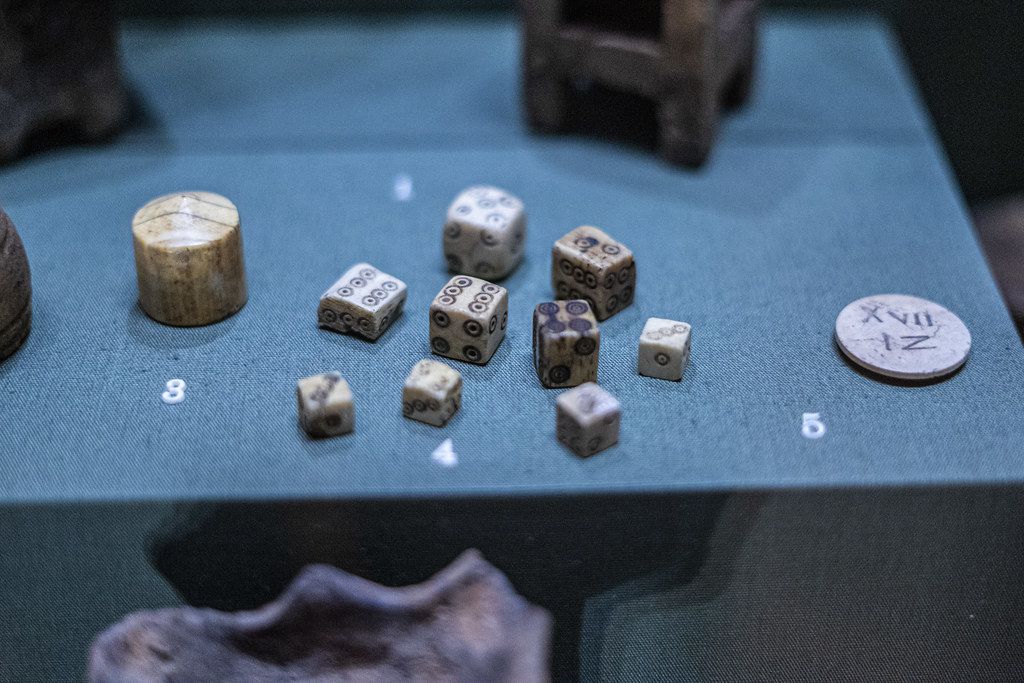
On a modern die, opposite faces always sum to seven: one faces six, two faces five, three faces four. That arrangement was not universal from the start. According to the archaeozoologist Hans Christian Küchelmann, quoted by IFLScience, the first cubic dice with this numbering appeared in Egypt's New Kingdom in the 16th century BC. How and when it became the general rule is less clear, and older dice with other arrangements show that makers did not always follow it.
Dice were not invented in one place at one moment. They grew out of a long practice of throwing bones, passed through stick-shaped dice like those of the Burnt City, and only later settled into the numbered cube with sevens on opposite faces. Anyone who rolls a die today is using an object whose basic idea is several thousand years old, and whose standard layout is younger than the oldest dice themselves.
Dates and details follow the sources named below. Where historians disagree or a story is a legend, the article says so. Corrections are welcome through the contact page.