Playing Card Suits Explained
What Do the Four Card Suits Mean? The History of Hearts, Spades, Diamonds and Clubs
The four suits of a modern deck did not begin as symbols of medieval social classes. They are a French simplification of older suit systems that reached Europe from the Islamic Mamluk world in the 14th century, and the popular "four estates" reading is a later interpretation that no documented source supports.
From Mamluk Cards to European Suits
Playing cards are generally thought to have begun in China, but the route by which they reached the Islamic world is not documented in detail. According to Encyclopaedia Britannica, cards first appeared in Europe in the 1370s, probably in Italy or Spain, and were already associated with imports from the Mamluk sultanate centered in Egypt.
The Mamluk deck used four suits: cups, coins, swords and polo sticks. A fragmentary card at the Los Angeles County Museum of Art is described as coming from such a deck, with ten number cards and three court cards in each suit. The court cards were a king, an upper viceroy and a lower viceroy. A rare, incomplete Mamluk deck also survives at the Topkapı Palace Museum in Istanbul. Britannica states that the international 52-card deck evolved in Europe from this original Mamluk pattern.
European card makers adapted the suits to local taste. Italian and Spanish cards kept cups, coins and swords, and turned the unfamiliar polo sticks into batons or clubs; these "Latin" suits are still used in Italy and Spain. German makers went their own way with hearts, bells, leaves and acorns.
How France Set the Standard
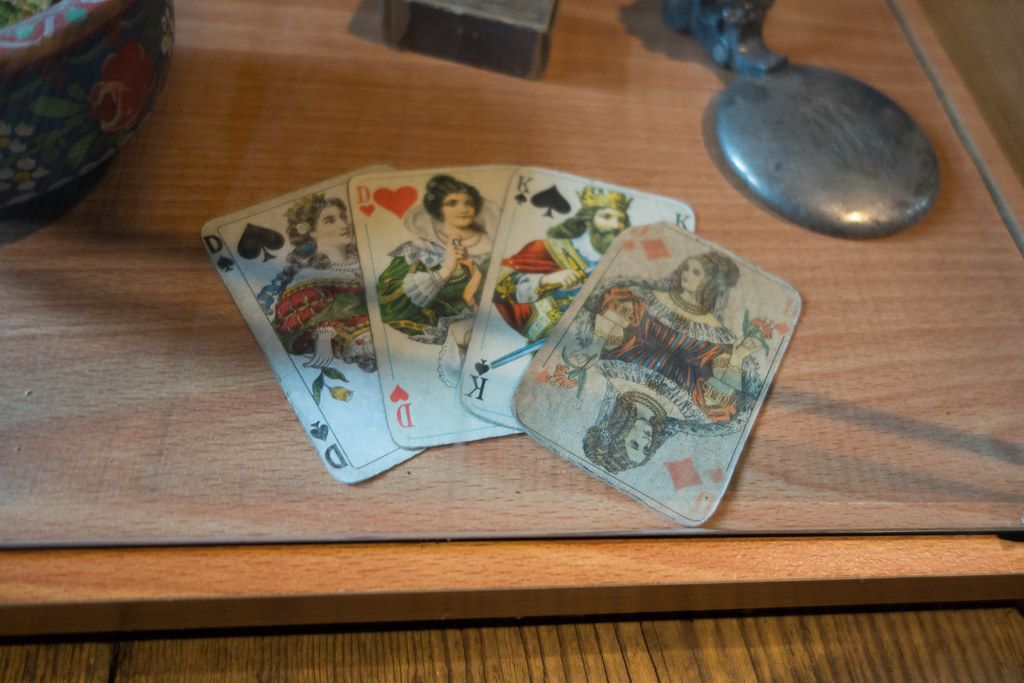
In the 1480s, French card makers introduced simpler suitmarks that could be applied with stencils, which made cards easier to produce. Their names were pique, coeur, carreau and trèfle, known in English as spades, hearts, diamonds and clubs. These French suits spread through trade and became known as the international suits, the ones found in most decks sold today.
The French also gave names to their court cards. On the standard Paris pattern, the kings are labeled David for spades, Charles for hearts, Caesar for diamonds and Alexander for clubs. Those names are printed on the cards and are well documented. What is not documented is the popular claim that each king is a portrait of a particular ruler, or that the King of Hearts, for example, is certainly Charlemagne. Those identifications are legend and guesswork, and the English and American cards most readers know carry no names at all.
The Four Estates Myth
A widely repeated explanation holds that the suits stand for the four classes of medieval society: hearts for the clergy, spades for the nobility, diamonds for merchants and clubs for peasants. Britannica and the museum collections do not support it. None of the standard sources on the Mamluk and early European decks ties the suit symbols to social classes, and the objects on the earliest cards were courtly items such as cups, coins, swords and polo sticks rather than a planned map of society. The allegory appears to be a later interpretation laid over symbols that had already been simplified for printing.
The modern deck is a simplified survivor of older suit systems, carried from the Mamluk world to Italy and Spain, reworked in Germany and France, and then exported worldwide. The legends about estates and royal portraits are attractive because they promise a hidden code in an everyday object. The documented history is plainer, and in its own way more interesting: the suits people shuffle today are the result of six centuries of borrowing, translation and practical printing choices.
Dates and details follow the sources named below. Where historians disagree or a story is a legend, the article says so. Corrections are welcome through the contact page.